Why Becoming a Certified Permanent Makeup Artist Is More Than Just Training
A certified permanent makeup artist is a cosmetic professional who has completed formal training, passed industry-recognized exams, and met the safety standards required to perform procedures like microblading, powder brows, and lip blushing on real clients.
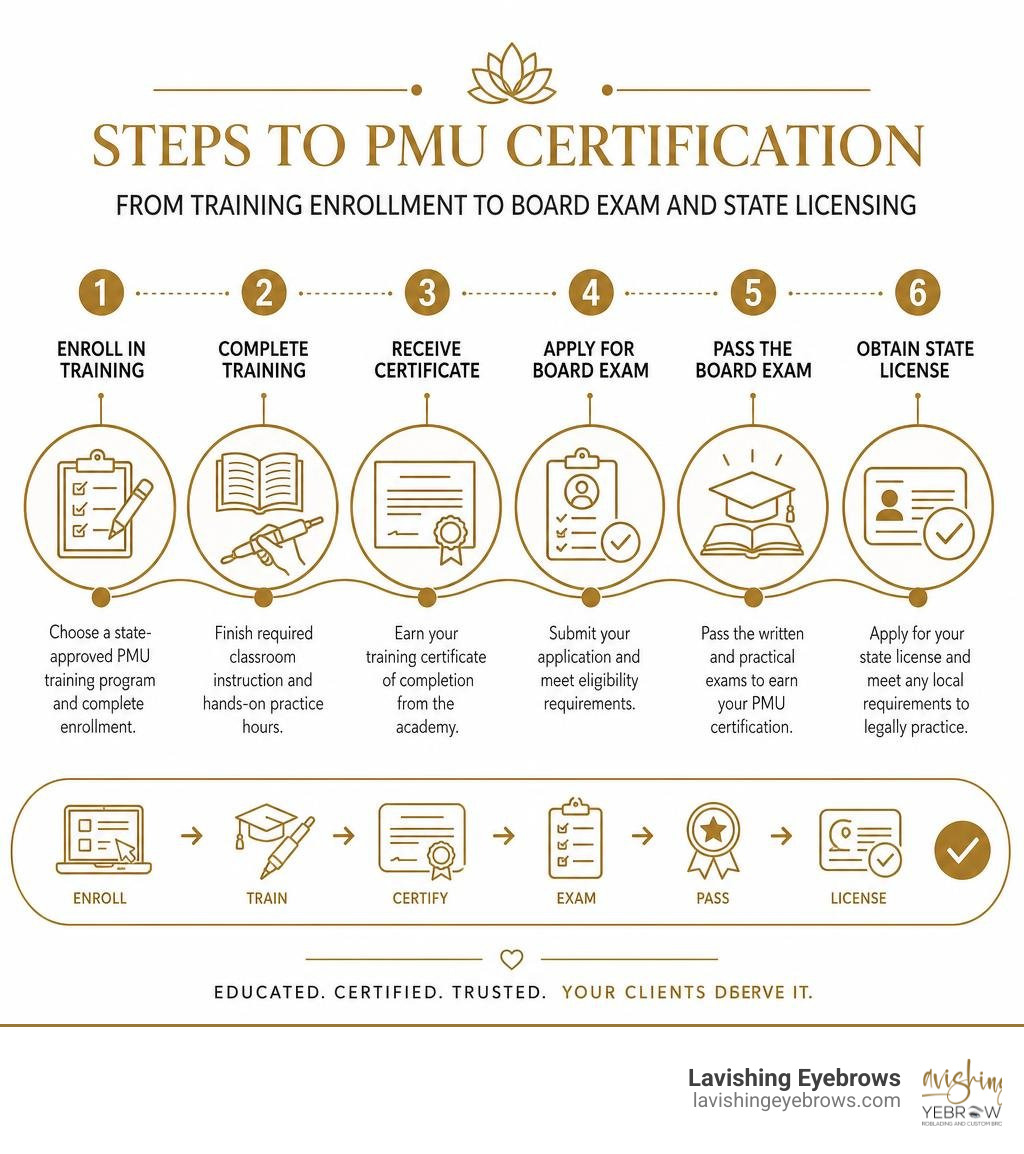
If you’re researching what certification actually involves, here’s a quick overview:
- What it is: Formal training in cosmetic tattooing techniques, safety protocols, and color theory — followed by a recognized certification exam
- Who oversees it: Organizations like the Society of Permanent Cosmetic Professionals (SPCP) offer board-recognized credentials such as the CPCP (Certified Permanent Cosmetic Professional)
- How long it takes: Most foundational programs run between 100 and 132 hours, typically completed over 5 to 7 days or spread across 5 weeks
- Why it matters for clients: A certified artist has proven knowledge of infection control, skin anatomy, and safe pigment use — reducing risk and improving results
- Why it matters for artists: Certification satisfies licensing requirements in most U.S. states and builds the client trust needed to grow a lasting career
The permanent cosmetics industry is on a strong growth trajectory, projected to reach $3.5 billion globally by 2030. That growth is driven by rising demand for skilled, credentialed professionals — not just anyone with a kit and a social media page.
Whether you’re a prospective artist weighing your training options, or a client trying to understand what separates a qualified professional from an untrained one, certification is the clearest signal of competence in this industry.
Key terms for certified permanent makeup artist:
What is a Certified Permanent Makeup Artist?
A certified permanent makeup artist is far more than someone who knows how to draw a pretty eyebrow. In cosmetic tattooing, a certified professional is an artist who has successfully bridged the gap between fine art and medical-grade safety. Permanent makeup (PMU) involves depositing specialized pigments into the upper layers of the dermis. Because this process breaks the skin, it is legally and technically a form of tattooing.
To practice responsibly, an artist must master industry standards that go way beyond basic makeup application. This includes understanding skin anatomy, color theory, wound healing, and strict sterilization protocols. When a client lies down on a PMU table, they are placing their face—and their health—in the artist’s hands. True certification represents a formal, verified commitment to maintaining these high standards, ensuring that every brow, eyeliner, or lip blush procedure is as safe as it is beautiful.

Certification vs. General Training for a Certified Permanent Makeup Artist
It is common to see the words “trained” and “certified” used interchangeably, but in our industry, they mean very different things.
- General Training: This typically refers to attending a class, watching a demonstration, or completing a short online tutorial. Anyone can buy a PMU machine online, watch a few videos, and claim they have “training.” However, general training lacks standardized testing, objective evaluation, and regulatory oversight.
- Professional Certification: True certification requires completing a comprehensive, structured curriculum (typically a minimum of 100 hours of fundamental study) and passing a rigorous, independent board examination. It involves hands-on practice under the direct supervision of a master instructor.
To understand the dedication required to build a successful career, you can read our deep dive into the educational journey in The Art of Lasting Beauty: A Comprehensive Path to Becoming a Permanent Makeup Artist.
Why Professional Certification Matters for Artists and Clients
For artists, holding a recognized certification is the ultimate business builder. It establishes instant credibility, allowing you to stand out in a crowded market. It also opens doors to professional liability insurance, high-quality pigment vendors, and advanced training opportunities.
For clients, an artist’s certification is their safety net. PMU procedures carry inherent risks if performed incorrectly, including infection, scarring, allergic reactions, and undesirable pigment migration. A certified artist is trained extensively in infection control and bloodborne pathogens, ensuring that the workspace remains entirely sterile.
Before booking any cosmetic tattoo, clients often ask, “Is this safe?” We address these vital safety protocols in detail in our guide: Is Microblading Safe?.
Leading PMU Certification Organizations and Credentials
The permanent makeup industry is self-regulated in many aspects, which is why national and international non-profit organizations have stepped in to set uniform benchmarks. These organizations establish the code of ethics, safety guidelines, and educational requirements that define professional excellence.
For those of us practicing in Southern California – specifically across Southwest Riverside County in cities like Murrieta, Temecula, Menifee, Lake Elsinore, and Corona – aligning with these major credentials helps ensure our work meets or exceeds both national standards and local California health department regulations. One of the best-known professional organizations in this field is the Society of Permanent Cosmetic Professionals, which provides industry education, guidelines, and credentialing resources for permanent cosmetics professionals.
Understanding SPCP Credentials (CPCP and CPTP)
The Society of Permanent Cosmetic Professionals (SPCP) is one of the largest and most respected non-profit associations in the industry. It is dedicated to promoting safety, excellence, and professional standards. The SPCP offers two primary board-certification exams:
- CPCP (Certified Permanent Cosmetic Professional): This is the gold standard for traditional cosmetic tattooing. To earn the CPCP designation, an artist must pass a comprehensive board exam covering safety, sanitation, client consultation, color theory, and technical application.
- CPTP (Certified Paramedical Tattoo Professional): This advanced credential focuses on paramedical tattooing. This specialized field includes 3D areola simulation for breast cancer survivors, scar camouflage, and vitiligo repigmentation.
Earning these credentials requires significant preparation and ongoing continuing education to maintain. To learn more about what it means to work with a certified microblading specialist, explore our resources under the Tag: Certified Microblading.
How State Licensing Interacts with National Certification
It is crucial to understand that national certification is not the same as state licensing.
- National Certification (e.g., SPCP): Validates your professional knowledge, technical skill, and artistic competence on a national level.
- State and Local Licensing: Dictates your legal right to practice in a specific geographic area.
In California, body art, including permanent makeup, is regulated at the county level under the California Safe Body Art Act. To practice legally in Riverside County, an artist must obtain a practitioner registration from the local Environmental Health Department, work out of a permitted, inspected facility, and maintain a current Bloodborne Pathogens certificate.
| Feature | National Certification (e.g., CPCP) | State/County Licensing (e.g., Riverside County Practitioner Registration) |
|---|---|---|
| Issued By | Professional industry boards (non-profit) | Government health departments |
| Primary Focus | Technical skill, color theory, artistry, advanced safety | Basic sanitation, facility safety, legal permission to practice |
| Requirement | Voluntary (but highly recommended for credibility) | Mandatory by law to perform procedures |
| Testing | Rigorous board exams and educational hour requirements | Bloodborne Pathogens certificate and annual registration fees |
| Scope | Nationally and internationally recognized | Limited to the specific state, county, or city jurisdiction |
Inside a Certified Permanent Makeup Artist Training Program
If you are looking to become a certified permanent makeup artist, you must enroll in a high-quality, comprehensive training program. Rushed, weekend-only courses simply do not provide the depth of knowledge required to tattoo someone’s face safely.
A standard, reputable fundamental program requires a minimum of 100 to 132 hours of study. This is typically split between independent pre-course study (such as bloodborne pathogens and anatomy) and intensive, hands-on classroom training.
Core Topics and Skills Covered in PMU Training
A comprehensive training curriculum is designed to turn students into well-rounded, safe, and artistic practitioners. The core topics generally include:
- Skin Anatomy and Physiology: Understanding the layers of the skin, healing processes, and how different skin types (oily, dry, mature) retain pigment.
- Color Theory and Pigmentology: Learning the difference between organic and inorganic pigments, identifying warm and cool skin undertones, and mastering how to mix pigments to prevent brows from turning blue, grey, or red over time.
- Facial Mapping and Symmetry: Designing custom brow shapes, eyeliner, and lip outlines that complement the client’s unique bone structure.
- Technical Application: Practicing proper needle depth, machine speed, hand posture, and stretch techniques.
To see the diverse range of techniques that a certified professional must master, view our full menu of Services.
Beginner, Advanced, and Specialized PMU Courses
The learning journey of a permanent makeup artist is structured in tiers:
- Beginner Fundamentals: These courses focus on the basics of cosmetic tattooing. Students learn classic techniques such as microblading (using manual hand tools) and basic powder/shading brows.
- Advanced Courses: Once an artist has mastered the basics, they can take specialized classes to learn advanced techniques. This includes nano brows (using a single needle machine to create ultra-fine hair strokes), shaded eyeliner, and lip blushing.
- Specialized/Paramedical Training: This highly advanced level covers scar camouflage, 3D areola restoration, and scalp micropigmentation.
To explore the differences between these modern procedures, read our comprehensive guide on Permanent Makeup.
Essential Supplies, Equipment, and Post-Training Support
A quality training academy does not just send you home with a certificate; they set you up for long-term success. This starts with a professional startup kit.
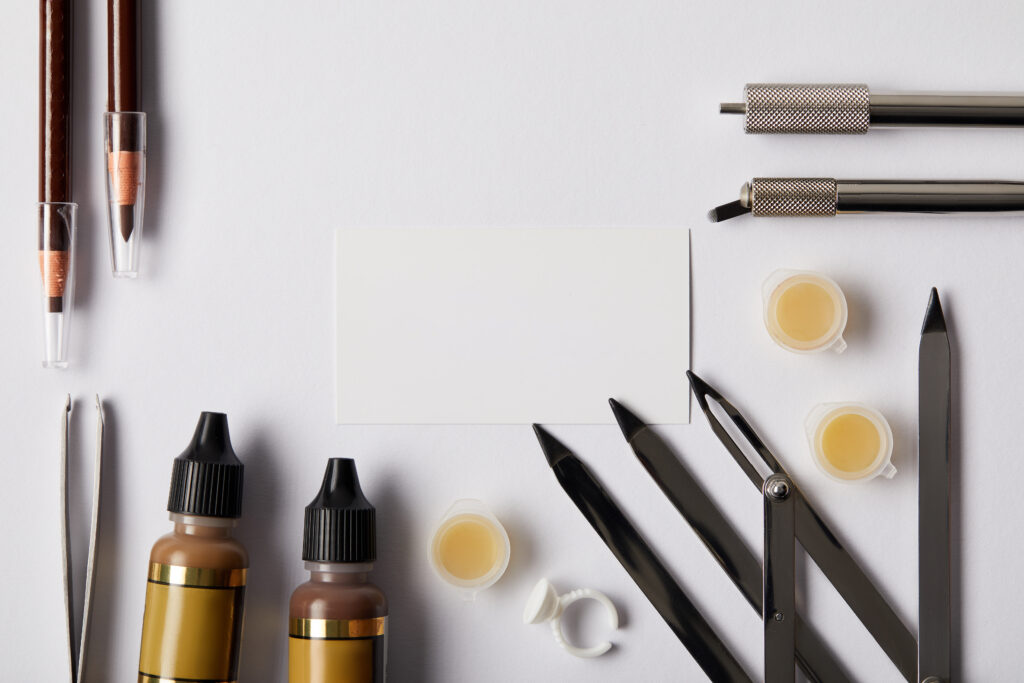
A high-quality startup kit (often valued at over $600) should include:
- A professional-grade rotary PMU machine and power supply
- An assortment of sterile needle cartridges
- A selection of premium, US-sourced pigments
- Mapping tools (calipers, thread, mapping pencils)
- Practice latex skins
- Anesthetics (primary and secondary numbing gels)
Furthermore, the best programs offer ongoing mentorship. Having direct access to an instructor for advice on color choice, healing patterns, or business setup during your first year of practice is invaluable.
The Benefits of Choosing a Certified Permanent Makeup Artist
When clients in Southwest Riverside County look for permanent makeup, they are spoiled for choice. From Temecula to Corona, there are countless beauty salons offering microblading. However, choosing a certified professional over an uncertified one is the single most important decision a client can make for their face. By choosing a certified expert, you ensure that your procedure is performed with the highest standards of safety, hygiene, and artistic precision.
Why Clients Trust a Certified Permanent Makeup Artist
A certified artist treats your face like a unique piece of fine art, not a template. At Lavishing Eyebrows in Murrieta, our owner Vicky—who was trained by world-class institutions including the World Microblading Academy, PHI Brow Academy, and Mystique Brow Academy—combines a perfectionist’s eye with a warm, reassuring consultation process.
Certified artists understand that client trust is built on:
- Customization: Designing brows based on individual facial geometry rather than using generic plastic stencils.
- Skin Type Expertise: Knowing which technique will heal best on your specific skin type (for example, recommending soft powder brows over microblading for oily skin).
- Premium Products: Using only high-quality, US-sourced, FDA-compliant pigments that fade naturally over time without shifting to unnatural colors.
How to Verify an Artist’s Credentials and Portfolio
Before booking an appointment, clients should do a little homework. Do not rely solely on heavily filtered social media photos.
Here is how to verify an artist’s credentials:
- Ask to See Certificates: A reputable artist will proudly display their fundamental training certificates, advanced academy credentials, and county health permits in their studio.
- Study Healed Portfolios: Anyone can take a beautiful photo immediately after a procedure when the skin is fresh. Ask to see photos of completely healed results (at least 4 to 6 weeks post-procedure) to judge the true quality of their work.
- Check Reviews: Look for consistent praise on Google or Yelp regarding the artist’s cleanliness, professionalism, and healed results.
Frequently Asked Questions about PMU Certification
How long does it take to get certified in permanent makeup?
The classroom portion of a fundamental PMU course typically takes 5 to 7 days (for intensive, full-time programs) or is spread across 5 weeks (for part-time programs of about 132 hours). However, becoming truly proficient takes time. Many artists spend several months practicing on latex skin and working under an apprenticeship model before they feel fully confident working independently on clients.
How much does a PMU certification course cost?
PMU training is a significant investment in your career. High-quality fundamental courses generally range from $3,500 to $6,000, depending on the length of the class, the size of the student group, and the quality of the startup kit included.
Typical startup and training costs include:
- Fundamental 5-Day Course: $4,500 – $6,000 (often requires a non-refundable deposit of $850 – $1,000 to secure enrollment)
- Bloodborne Pathogens Certification: $25 – $50
- Advanced Specialized Add-ons (e.g., Lip Blushing): $1,500 – $2,500
- County Practitioner Licensing & Health Permits: $150 – $300 annually
Many top-tier academies offer financing options to help students manage these upfront tuition costs.
Do I need a tattoo license if I am already certified?
Yes. In almost every state, including California, having a certificate from a PMU school does not grant you the legal right to practice. You must also obtain a local body art practitioner registration (often referred to as a tattoo license) from your county’s environmental health department. Operating without this license is illegal and can result in steep fines and the closure of your business.
Conclusion
Becoming a successful, certified permanent makeup artist requires a blend of rigorous technical training, a deep commitment to safety, and continuous artistic refinement. For clients, choosing an artist with these verified credentials is the absolute best way to ensure gorgeous, natural-looking results that safely restore confidence.
At Lavishing Eyebrows in Murrieta, CA, we are proud to serve our wonderful community across Southwest Riverside County, including Temecula, Menifee, Lake Elsinore, and Corona. Our owner, Vicky, is a highly certified brow specialist whose perfectionist artistry and warm, reassuring approach make even the most nervous clients feel completely at ease. We treat every set of brows as a unique masterpiece, using only premium, US-sourced products to deliver soft, beautiful, and lasting results.
Are you ready to wake up every morning with perfect, effortless brows? Book your personalized consultation with us today at https://lavishingeyebrows.com/menifee-microblading/ and let us help you restore your natural beauty!